How Do Cats and Dogs See, Hear, and Smell the World? The Perceptual World of Our Pets
Sedat Çapanoğlu, DVM
Anka Veterinary Clinic
Last updated:
Mustafa Kemal University graduate (2018). After clinical experience in Mersin and a short period in municipal shelter practice, he takes an active role in surgery, emergency care, dental health, and diagnostics.
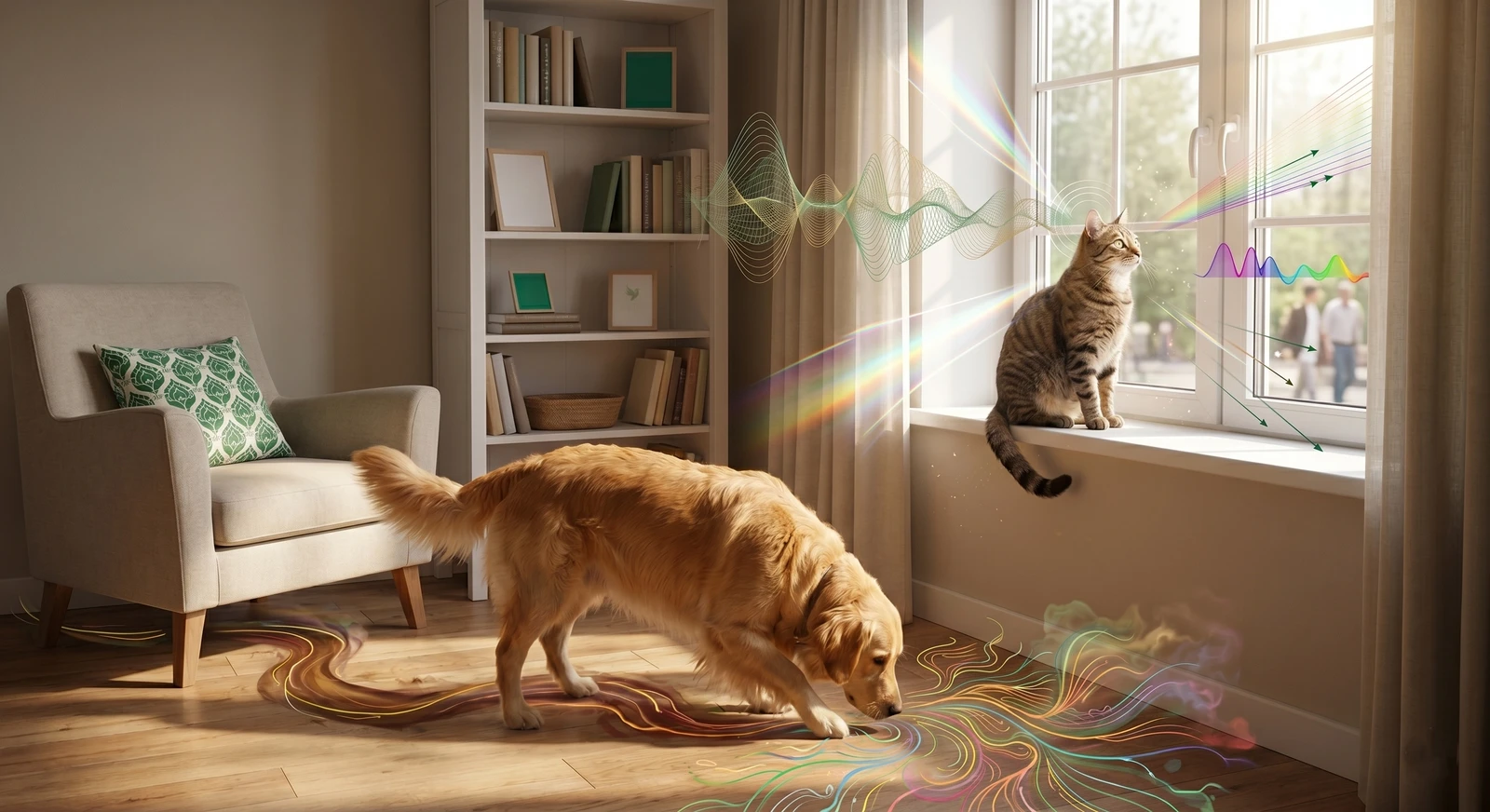
A room that seems utterly ordinary, silent, and static to humans can be an entirely different map filled with scents, sounds, lights, and textures for cats and dogs. As you sit on the couch sipping your coffee, you might think everything around you is perfectly calm. Yet your pet may hear faint sounds in the walls, detect aromas from the kitchen, and feel subtle air currents with the tips of their whiskers.
The way pets perceive the world is shaped by specialized systems that evolved for survival, hunting, protection, and environmental awareness. Understanding this sensory world helps create a calmer and more comfortable home environment. At Anka Veterinary Clinic in Mersin Mezitli, we closely monitor your pet’s well-being with preventive care.
What You Will Learn in This Guide
- 1Do Pets Perceive the World the Way Humans Do?
- 2How Do Cats See?
- 3How Do Dogs See Colors?
- 4Why Is Feline Night Vision So Impressive?
- 5What Sounds Do Cats and Dogs Hear?
- 6Why Is the Sense of Smell Like a Map for Dogs?
- 7What Is the Function of Whiskers and Touch in Cats?
- 8Human, Cat, and Dog Perception Comparison
- 9How Can This Information Be Used at Home?
- 10Open Spaces and Sensory Enrichment in Mersin Mezitli
- 11Sources and Notes
- 12Frequently Asked Questions
01Do Pets Perceive the World the Way Humans Do?
Humans rely heavily on sight to make sense of the world, scanning details, colors, and objects before making decisions. Pets have different sensory priorities. For a dog, the world is largely made of smells and sounds. A cat interprets the environment through a visual system tuned for movement, sensitive whiskers, and a broad hearing range.
Their senses are not inferior to those of humans; they are simply tuned to a different reality. They can perceive many sounds, scents, movements, and textures that escape human notice.
02How Do Cats See?
A cat’s eye structure helps them see better in low light and detect motion quickly. A higher density of rod cells in the retina makes it easier to track small moving objects in dim environments.
Cats have more limited color perception than humans. Blue and green tones are believed to be more distinguishable for them, while some other shades may look paler or less distinct.
Cats cannot see in complete, pitch-black darkness. Vision still requires a little light. In dim settings, however, they can navigate far more easily than humans.
03How Do Dogs See Colors?
The idea that dogs see only in black and white is incorrect. Dogs do see colors, but their color perception differs from ours.
Their visual system works somewhat like red-green color blindness in humans. Blue and yellow shades are more noticeable, while red and green may appear closer, paler, or grayish.
This is useful in daily life: a red toy on green grass may be hard for your dog to spot, while blue or yellow toys are usually easier to see outdoors.
04Why Is Feline Night Vision So Impressive?
One of the structures that helps cats see better in dim light is the tapetum lucidum, a reflective layer at the back of the eye. It reflects some light back into the eye, helping available light be used more efficiently.
This layer is also why cats’ eyes often glow green or yellow in photos. The sudden nighttime bursts of movement around the house can be related to this heightened motion perception and natural instinct.
05What Sounds Do Cats and Dogs Hear?
The human ear hears sounds up to about 20,000 Hertz. Cats and dogs can detect higher-frequency sounds that humans cannot hear. Exact ranges vary, but dogs can hear up to around 45,000 Hertz, while cats can detect even higher frequencies.
Vacuum cleaners, drills, food processors, slamming doors, thunder, or fireworks can be stressful for some cats and dogs. Preparing a quieter and safer retreat area can help them relax.
06Why Is the Sense of Smell Like a Map for Dogs?
For dogs, going outside is not just physical exercise; it is an opportunity to understand the environment through scent. Depending on breed, dogs may have around 100-300 million scent receptors, compared with about 5-6 million in humans.
When your dog sniffs a tree, a patch of grass, or the corner of a wall, they are reading traces left by other living beings. Planning some walks as relaxed “sniff walks” can support mental calm and enrichment.
07What Is the Function of Whiskers and Touch in Cats?
Cat whiskers, or vibrissae, are sensitive sensory structures. Their roots are richly connected to nerves and help detect air currents, close contact, and environmental changes.
Whiskers help cats judge tight spaces and perceive their immediate surroundings. They should never be trimmed, because cutting them can impair spatial awareness and cause stress.
Wide, shallow bowls may be more comfortable for cats that dislike their whiskers brushing against narrow bowl edges.
08Human, Cat, and Dog Perception Comparison
| Sense | Human | Cat | Dog | What it means at home |
|---|---|---|---|---|
| Color perception | Broad color differentiation | More limited color perception | Blue and yellow are more noticeable | Blue/yellow dog toys are easier to spot outdoors. |
| Night vision | Limited in low light | Advantageous in dim light | Better than humans in dim light | Cats track movement more easily in low light. |
| Motion perception | Strong focus on static objects | Tuned to rapid movement | Strong distance and motion tracking | Moving toys are more engaging for cats and dogs. |
| Hearing | Up to about 20,000 Hz | Sensitive to high frequencies | Sensitive to high frequencies | Vacuums, drills, and sudden noises may distress some pets. |
| Smell | About 5-6 million receptors | More developed than humans | Around 100-300 million receptors by breed | Sniff walks provide mental enrichment for dogs. |
| Touch / whiskers | Focused on fingertips and skin | Whiskers are critical for spatial awareness | Whiskers support close-range perception | Never cut cat whiskers; choose wide bowls. |
Color perception
Night vision
Motion perception
Hearing
Smell
Touch / whiskers
09How Can This Information Be Used at Home?
Choose blue or yellow toys for your dog, create a safe window perch for your cat, and allow your dog to stop and sniff during some walks.
A quiet corner during loud appliance use, fewer heavy perfumes or room sprays, and wide food bowls for cats can all improve daily comfort.
If sensitivity to sound, smell, or environmental stimuli disrupts daily life, a more personalized behavioral assessment may be useful.
10Open Spaces and Sensory Enrichment in Mersin Mezitli
For cats and dogs living in Mersin Mezitli, coastal walks, parks, and indoor window perches can provide valuable sensory enrichment. On the Mezitli coastline, your dog is not only exercising; they are also processing sea breeze, surrounding sounds, and scent trails in the grass.
For indoor cats, safe and sunny window perches can make daily life more engaging. Understanding sensory needs is part of supporting overall quality of life.
Short Summary
Cats and dogs perceive the world through different channels than humans do. Their color perception is not a flaw; it is a different sensory mode suited to their nature. Cats have an advantage in dim light, dogs make sense of the world through scent, and both species can hear some sounds more acutely than humans can.
Adjusting toy choices, walking routines, loud appliance use, food bowls, and scent intensity at home can help pets feel more comfortable.
Note from Mersin Ankavet
Our companions' way of perceiving the world is much more sensitive and different from ours. You can get professional support from our veterinarians to support their sensory and behavioral development and minimize stressors.
Book AppointmentRelated Blog Posts
Sources and Notes
- Merck Veterinary Manual - Physical Description and Senses of Cats
- Merck Veterinary Manual - Eye Structure and Function in Dogs
- VCA Animal Hospitals - Do Cats See Color?
- VCA Animal Hospitals - Whiskers: Radar Sensors and More
This content has been prepared for informational purposes and does not replace a professional veterinary examination.
Frequently Asked Questions
Do dogs see colors?
Yes, dogs see colors, but differently from humans. Blue and yellow shades are more noticeable, while red and green tones may appear closer, paler, or grayish.
Can cats really see in the dark?
Cats cannot see in a completely lightless environment. They still need some light, but their eye structure gives them a clear advantage in dim settings.
Why does my dog constantly sniff on walks?
Sniffing is one of the main ways dogs gather information about their surroundings. Relaxed sniff walks can be mentally enriching and calming.
Is it harmful to cut my cat’s whiskers?
Yes. Cat whiskers are sensitive sensory structures that support spatial awareness. Cutting them can cause stress and make close-range orientation harder.
Why do pets get bothered by loud noises?
Cats and dogs can detect some sounds more sensitively than humans. Vacuums, drills, thunder, or fireworks may therefore feel intense and stressful.
Do cats and dogs watch television?
Some cats and dogs show interest in moving images on television, especially birds, balls, or other animals. Interest varies from pet to pet.
Do perfumes and air fresheners affect pets?
Yes. Strong perfumes, incense, room sprays, or harsh cleaning agents can irritate some pets and cause sneezing, restlessness, or avoidance.
Related Service
Behavior and Psychology
For clinical evaluation and a care plan, review the service page connected to this guide.
View ServiceMedical Information Note
This content is for general information only. It does not replace a veterinary examination, diagnosis, treatment, or specific medication/food recommendations. A veterinary examination and individual assessment are required for your pet’s health. In case of emergency symptoms, please contact the nearest open veterinary clinic.
MERSIN MEZITLI PET CARE
Need Professional Guidance for Your Pet?
Are you in Mersin Mezitli? If you notice these symptoms or have any concerns about your pet’s health, consult our AnkaVet veterinarians immediately. English and Russian-speaking support is available!
Your pet deserves quality care.
Get in touch today to discuss your pet’s health or schedule a consultation.