Does My Cat Love Me? 9 Signs Your Cat Loves You
Sedat Çapanoğlu, DVM
Anka Veterinary Clinic
Last updated:
Mustafa Kemal University graduate (2018). After clinical experience in Mersin and a short period in municipal shelter practice, he takes an active role in surgery, emergency care, dental health, and diagnostics.
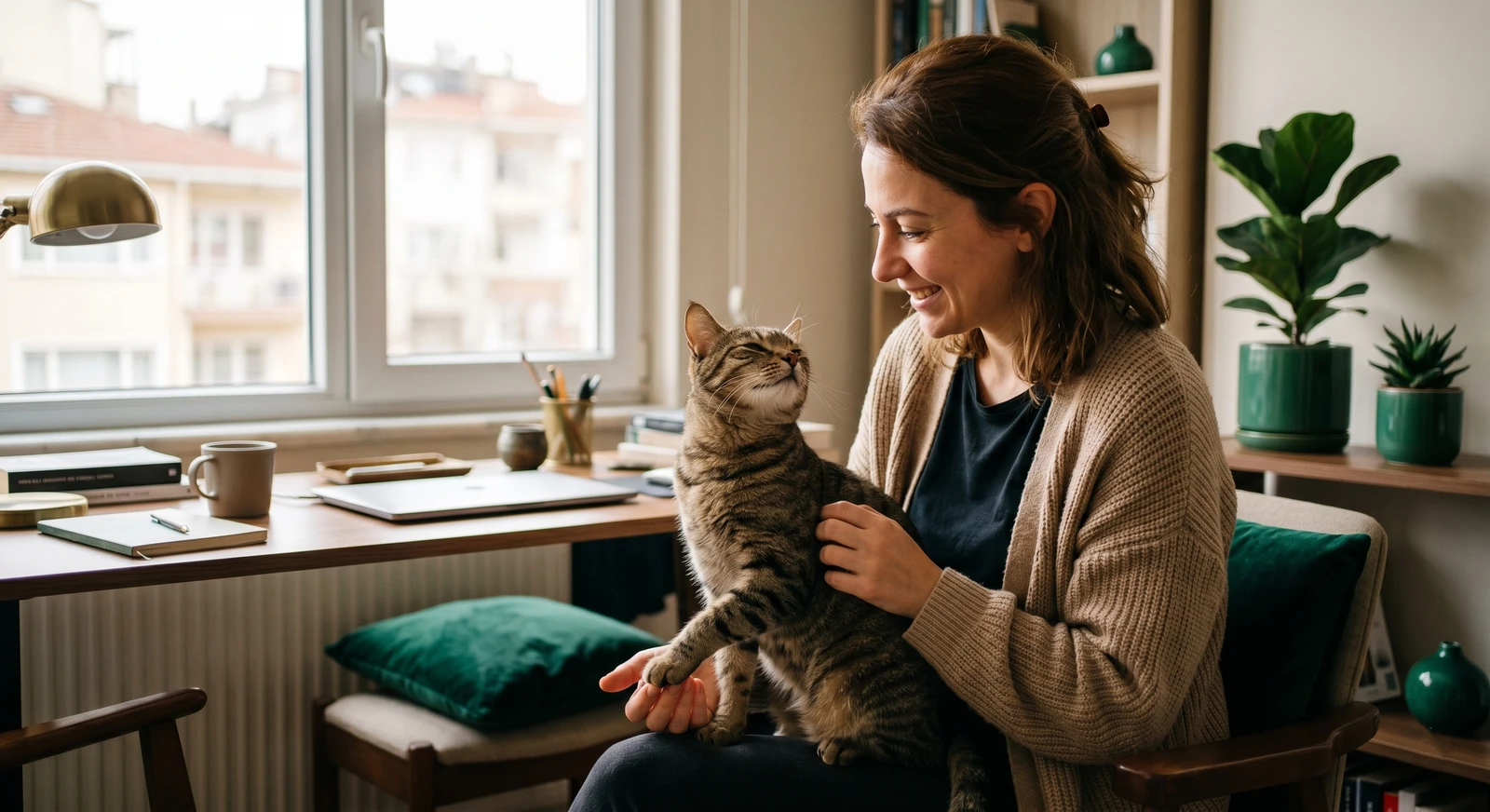
Cats are among the most frequently misunderstood animals in the pet world. People accustomed to the more obvious affection of dogs may sometimes interpret a cat’s calmer and more selective behavior as aloofness or indifference.
In reality, cats often express love through subtler cues: slow blinking, relaxing beside you, rubbing against you, following you from room to room, or initiating play are all ways they form social bonds.
Scientific studies also confirm that cats can form social bonds with humans. A 2019 Current Biology study reported that many cats show secure attachment behaviors toward their caregivers. Your cat’s interest in you is far too rich to be explained only by the food bowl.
At Anka Veterinary Clinic in Mersin Mezitli, 9 common behaviors are explored cats use to show affection in this article, looking at them through both feline psychology and everyday home life.
What You Will Learn in This Guide
01Why Do Cats Show Affection Differently?
The healthiest way to understand cat behavior is to read each action in context and compare it with your cat’s own normal personality. The same behavior can be a play invitation in one cat and a boundary-setting signal in another.
029 Signs Your Cat Loves You
| Sign | What It Might Mean | Points to Keep in Mind |
|---|---|---|
| Slow blinking | Trust and relaxation | Instead of staring, try slowly blinking back |
| Head bunting | Scent sharing and social bonding | Do not force a response; let your cat initiate |
| Kneading | Relaxation and comfort | Use a thin blanket if their claws prick you |
| Question mark tail | Friendly greeting | A stiffly swishing tail may indicate tension |
| Relaxed lounging nearby | Choosing you as a safe space | Exposing the belly is not always an invitation for rubs |
| Bringing toys | Initiating play and sharing | Actual prey bringing should be managed differently |
| Licking | Social grooming and bonding | Excessive licking can indicate stress or skin issues |
| Relaxed purring | Peace and contentment | Should not be confused with pain or stress purring |
| Following you around | Closeness and curiosity | Overly clingy behavior may signal anxiety |
Slow blinking
Head bunting
Kneading
Question mark tail
Relaxed lounging nearby
Bringing toys
Licking
Relaxed purring
Following you around
031. Slow Blinking: The Cat Kiss
Cats do not always find direct, prolonged eye contact comforting. When a cat looks at you calmly and slowly narrows, closes, and opens its eyes, it is widely interpreted as a sign of comfort and trust.
A 2020 Scientific Reports study showed that cats may respond positively to human slow-blinking stimuli, and some cats are more likely to approach a person after this interaction.
If your cat slow-blinks at you, you can respond calmly by slowly closing and opening your eyes. The goal is not to force the cat, but to communicate at their pace.
042. Head Bunting
Cats have scent glands around the forehead, cheeks, lips, and chin. If your cat rubs their head against your hand, face, or legs, this behavior is mostly associated with scent sharing and social bonding.
This behavior is known as bunting. By leaving their scent on you, your cat incorporates you into their familiar and safe environment.
053. Kneading
The rhythmic kneading motion cats make with their paws on blankets, pillows, or human laps is linked to nursing behavior from kittenhood. In adult cats, this behavior is usually associated with relaxation, peace, and a sense of security.
This behavior is covered in more detail in the previous article on quirky habits. If a cat is relaxed, purring, and kneading, the environment is likely perceived as safe and soothing.
If their claws hurt, placing a thin blanket on your lap is a better solution than punishing your cat.
064. The Question Mark Tail
A cat’s tail position provides important clues about their emotional state. If your cat approaches you with their tail held high and the tip slightly curled, it is generally a friendly greeting and a positive social approach.
A puffed-up tail, rapid stiff swishing, or a tense tail held close to the ground can indicate discomfort, fear, or agitation.
075. Relaxed Lounging Nearby
A cat relaxing beside you, whether on their back or side, can be a meaningful sign of trust. The abdominal area is a highly sensitive and vulnerable zone for cats.
However, exposing the belly does not always mean rub my belly. Many cats dislike being touched on the stomach and may react with a defensive swat or a gentle bite.
086. Bringing Toys or Gifts
Your cat may bring a toy mouse, a small ball, a plastic ring, or a favorite object to you. This behavior could be initiating play, asking for attention, sharing, or repeating a learned routine.
In outdoor cats, bringing actual prey can also occur. It is not entirely accurate to romanticize this only as bringing you a gift; hunting instincts, environmental stimuli, and learned behaviors all play a role.
In indoor cats, bringing toys can usually be understood as a desire to start interaction with you.
097. Social Grooming: Licking You
Cats can form social bonds by licking one another. This is called allogrooming, or social grooming. If your cat licks your hand, hair, or arm, they may view you as a safe part of their social circle.
Short, calm licking is usually social contact. But if your cat licks themselves or you excessively and obsessively, stress, pain, skin disease, or a behavioral issue may need to be considered.
108. Relaxed Purring
Purring is one of the most beloved sounds in cats, but on its own it does not always mean happiness. Cats may purr when relaxed, but also to self-soothe during stress, pain, or illness.
Purring should be read together with body language. If your cat is curled up in your lap, eyes half-closed, muscles relaxed, and tail calm, this purring is mostly associated with peace and contentment.
119. Following You Room to Room
If your cat follows you to the kitchen, sleeps near you while you work, or waits by the door when you enter the bathroom, this behavior is mostly associated with social closeness and curiosity.
Cats may prefer to be near people they find safe. Being in the same room as you does not mean they need to be in your lap constantly.
If following becomes excessive and is accompanied by distress when you are away, loss of appetite, excessive meowing, or litter box issues, separation anxiety or another behavioral problem should be evaluated.
12Do All Cats Show Affection in the Same Way?
No. A cat’s personality, socialization history, age, health status, and household routine all influence behavior. Some cats are very contact-seeking; others show love by staying in the same room, offering brief head bunts, or asking to play.
The idea that my cat does not love me because they will not sit on my lap is often incorrect. Cats build social bonds within their own comfort zones.
13When Should a Behavior Be Considered a Red Flag?
Affectionate behaviors should be evaluated within the context of the cat’s normal baseline personality. Sudden behavior change deserves attention.
Medical causes such as pain, dental issues, urinary tract problems, skin diseases, hormonal disorders, or age-related changes should be ruled out before assuming the cause is behavioral. At Mersin Ankavet Veterinary Clinic in Mersin Mezitli, we closely monitor our patients with tailored preventive protocols.
- A previously social cat suddenly starts hiding
- A normally calm cat reacts aggressively to touch
- Excessive licking, fur pulling, or restlessness
- Sudden aggression
- Changes in appetite, water consumption, or litter box habits
- Unusual and frequent purring, meowing, or nighttime restlessness
For sudden or significant behavior changes, behavior and psychology consultation can be planned as part of a clinical evaluation.
Short Summary
Cats express affection through subtle behaviors like slow blinking, head bunting, kneading, and purring. Recognizing these signals helps foster a deep and trusting companionship.
Note from Mersin Ankavet
Cats do not always show love loudly. Small signs like slow blinking, head bunting, relaxing beside you, purring, following you around, and initiating play can indicate trust and social bonding.
Book AppointmentRelated Blog Posts
Sources and Notes
- Humphrey, T. et al. (2020). The role of cat eye narrowing movements in cat-human communication. Scientific Reports.
- Vitale, K. R., Behnke, A. C., & Udell, M. A. R. (2019). Attachment bonds between domestic cats and humans. Current Biology.
- Shreve, K. R. V., Mehrkam, L. R., & Udell, M. A. R. (2017). Social interaction, food, scent or toys? Behavioural Processes.
This content has been prepared for informational purposes and does not replace a professional veterinary examination.
Frequently Asked Questions
Does my cat love me, or are they just hanging around for food?
Food can be a strong motivator for cats, but the bond is not limited to feeding. Studies show that many cats value human social interaction and can form secure attachments with their caregivers.
Why does my cat bite me and then start licking?
This can be related to play, increased arousal, or overstimulation. Gentle play bites may be part of social interaction for some cats; however, if it hurts, breaks the skin, or becomes frequent, it should not be dismissed as a love bite.
How can I increase my cat’s trust in me?
Trust strengthens when a cat’s boundaries are respected. Instead of forcing contact, let your cat initiate approach. Slow blinking, regular play, a calm voice, and a consistent daily routine help build trust.
My cat will not sit on my lap; does that mean they do not love me?
No. Some cats prefer limited physical contact. Sleeping in the same room, rubbing against you, following you, or asking to play can also indicate a social bond.
My cat suddenly became much clingier; is this a good thing?
Not always. Age, pain, illness, stress, or environmental change can make some cats clingier. If the change is sudden and comes with changes in appetite, drinking, litter box use, sleep, or vocalization, a veterinary examination is recommended.
Related Service
Behavior and Psychology
For clinical evaluation and a care plan, review the service page connected to this guide.
View ServiceMedical Information Note
This content is for general information only. It does not replace a veterinary examination, diagnosis, treatment, or specific medication/food recommendations. A veterinary examination and individual assessment are required for your pet’s health. In case of emergency symptoms, please contact the nearest open veterinary clinic.
MERSIN MEZITLI PET CARE
Need Professional Guidance for Your Pet?
Are you in Mersin Mezitli? If you notice these symptoms or have any concerns about your pet’s health, consult our AnkaVet veterinarians immediately. English and Russian-speaking support is available!
Your pet deserves quality care.
Get in touch today to discuss your pet’s health or schedule a consultation.