Heart Diseases and Murmur in Cats and Dogs: Night Coughing, Shortness of Breath, and Early Diagnosis
Şanssım Çapanoğlu, DVM
Anka Veterinary Clinic
Last updated:
Mustafa Kemal University graduate (2019). After internships in Adana and Izmir, she worked in clinical practice in Adana and focuses on preventive medicine and behavior.
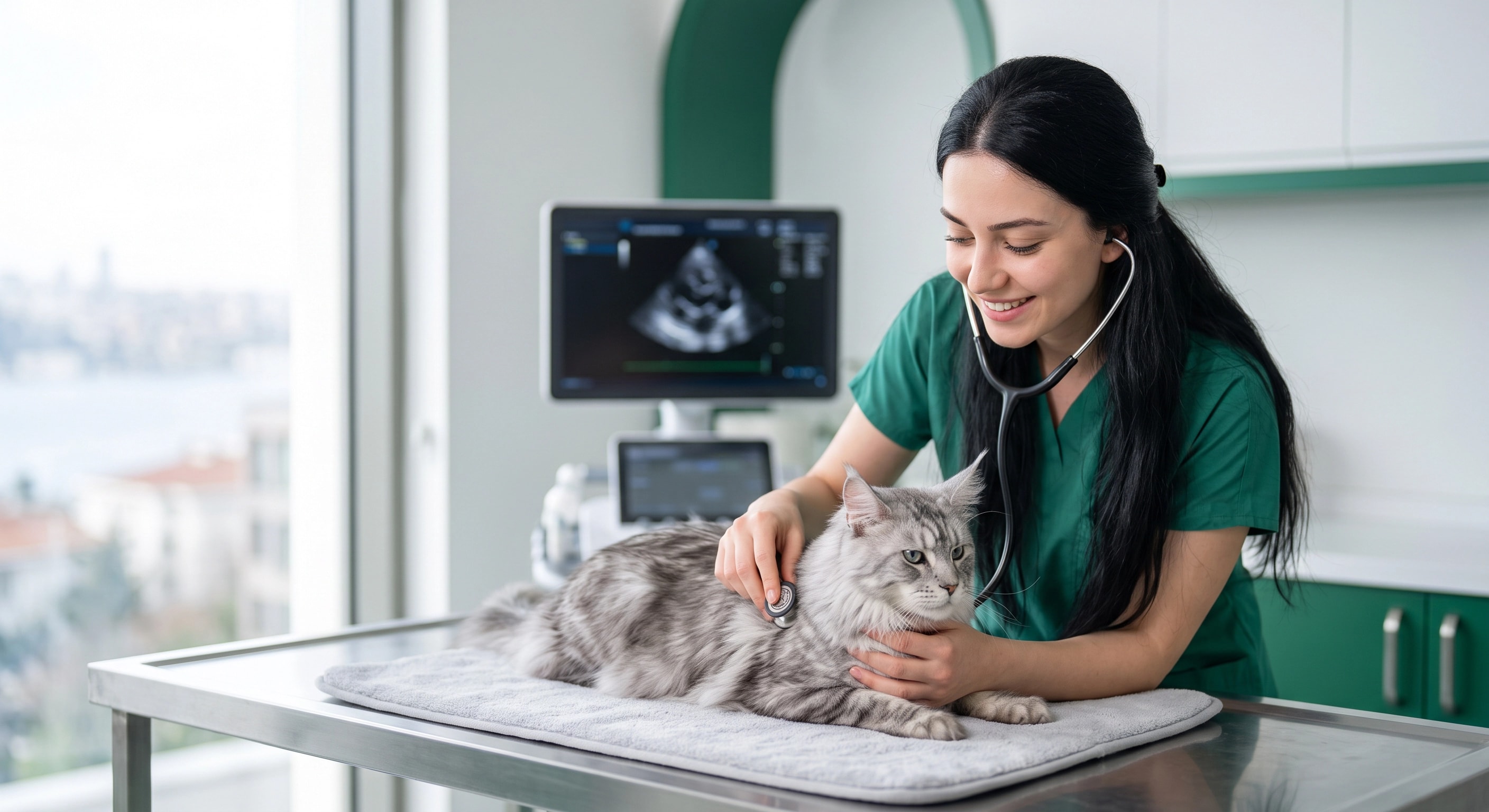
Have you noticed that your pet friend is not as energetic as before while playing, pants for a long time after a short run, or has a dry cough at night as if something is stuck in their throat? These symptoms, often seen as a natural consequence of old age or a simple cold, may actually be the silent cries of an insidiously progressing heart disease.
Especially the high humidity and hot weather of the Mersin and Mezitli region put severe stress on the circulatory system, causing hidden heart conditions to become more apparent. Unlike humans, cats and dogs exhibit evolutionary mastery in hiding pain in their chest or feelings of fatigue until the very last moment. For this reason, it is of vital importance to catch rhythm disorders, leaks, or muscle thickenings in the heart before they turn into heart failure. In this guide, we detail the frequently encountered heart problems in cats and dogs, murmur findings in veterinary examinations, and the life-saving sleeping respiratory rate (SRR) tracking you can do yourself at home from a cardiological perspective.
What You Will Learn in This Guide
- 1What is a Heart Murmur? The Difference Between Innocent and Pathologic Murmurs
- 2Comparison Table of Mitral Valve Disease (MMVD) in Dogs and HCM in Cats
- 3A Life-Saving Test at Home: How to Count the Sleeping Respiratory Rate (SRR)?
- 4Advanced Diagnosis in Heart Disease: ECHO, X-Ray, and NT-proBNP Test
- 5Living Environment and Exercise Management in Cats and Dogs with Heart Disease
- 6Cardiological Follow-up and Appointment Planning in Mezitli, Mersin
- 7Academic Sources and Further Reading
- 8Frequently Asked Questions
01What is a Heart Murmur? The Difference Between Innocent and Pathologic Murmurs
Listening to the chest with a stethoscope (auscultation) by veterinarians during routine examinations provides invaluable data about the health of the heart. When a healthy heart is working, the opening and closing sounds of the valves are heard clearly as a “lub-dub”. However, when the heart valves do not close completely or when there is an anatomical deterioration in the heart muscle, the blood deviates from its normal flow path and creates turbulence. The reflection of this turbulence heard through the stethoscope, resembling a “lub-shh-dub” sound, is called a “heart murmur”.
A heart murmur in dogs may not always be a harbinger of a fatal disease. Mild “innocent murmurs” heard especially in puppies and kittens under 6 months of age usually disappear on their own as the animal grows. However, murmurs that suddenly appear in adult or older (geriatric) pets are pathologic. This situation indicates that blood is flowing backward (leaking) in the anatomical structure of the heart or there is a narrowing in the vessels. Although the grade of the murmur (graded from 1 to 6) provides information about the severity of the disease, it is a medical necessity to always resort to advanced imaging techniques for a definitive diagnosis.
02Comparison Table of Mitral Valve Disease (MMVD) in Dogs and HCM in Cats
| Disease Type | Most Commonly Seen Species | Main Symptoms | Diagnostic Method |
|---|---|---|---|
| MMVD (Myxomatous Mitral Valve Degeneration) | Small/Medium Breed Older Dogs (Cavalier, Poodle, Terrier, etc.) | Night coughing, exercise intolerance, fainting (syncope) in dogs. | Echocardiography (ECHO) and Chest X-Ray. |
| HCM (Hypertrophic Cardiomyopathy) | Cats (e.g., Scottish Fold, British Shorthair, Maine Coon) | Open-mouth breathing, sudden paralysis in hind legs (Thromboembolism). | Echocardiography (ECHO) and NT-proBNP Blood Test. |
MMVD (Myxomatous Mitral Valve Degeneration)
HCM (Hypertrophic Cardiomyopathy)
03A Life-Saving Test at Home: How to Count the Sleeping Respiratory Rate (SRR)?
The most reliable way at home to understand whether your pet is at risk of heart failure or whether the heart medications they are using are working is the Sleeping Respiratory Rate (SRR) test. When fluid begins to accumulate in the lungs (edema), the animal starts breathing much faster even in its sleep to get oxygen. To perform the SRR test correctly, the following steps should be followed:
- Moment of Deep Sleep: Quietly approach your friend when they are in a completely deep sleep (a calm moment when they are not dreaming).
- Chest Movement: The rising and falling of the rib cage once is counted as “1 breath”.
- Time Tracking: Using a stopwatch, count the breaths for exactly 1 minute (60 seconds).
- Critical Threshold Value: The sleeping respiratory rate of a healthy cat or dog in deep sleep should be under 30 breaths per minute. If this number goes above 30 per minute for a few consecutive days or reaches 40 while resting, the risk of pulmonary edema due to heart failure is quite high, and a clinic should be consulted without wasting time.
04Advanced Diagnosis in Heart Disease: ECHO, X-Ray, and NT-proBNP Test
Although listening with a stethoscope (auscultation) makes the presence of the disease felt, veterinary echocardiography devices come into play to determine the stage of the disease and which medication should be used.
Echocardiography (Heart Ultrasound) shows the dimensions of the heart chambers, muscle thickness (which is the gold standard in diagnosing feline heart enlargement HCM), and the amount of blood leaking from the valves instantly and in color (Doppler). A chest x-ray, on the other hand, clearly reveals whether the general silhouette of the heart has enlarged and the fluid accumulation (edema) in the lungs that triggers the night coughing picture in dogs.
The NT-proBNP blood test, which comes into play in current cardiology approaches, is a very sensitive biomarker showing how stretched and stressed the heart muscle is. Especially in cats that are difficult to examine under stress, it allows hidden heart diseases to be detected at the cellular level before presenting clinical symptoms.
05Living Environment and Exercise Management in Cats and Dogs with Heart Disease
After a cardiological diagnosis is made, in addition to medical treatment (medications), indoor living standards must also be rearranged in a way that will not tire the heart:
- Temperature and Humidity Control: Heart patients lose their tolerance to heat. During the highly humid summer months of Mersin, it must be ensured that your friend always rests in air-conditioned or well-ventilated cool areas.
- Exercise Restriction: Sudden strenuous activities that abruptly raise the heart rate, such as playing fetch, long runs, or going up and down stairs, should be restricted. Walks should be kept short and at a mild pace in the cool of the evening rather than during hot hours.
- Diet Modification: Sodium (salt) consumption must be restricted in heart patients. A transition should be made to physician-recommended “Cardiac” clinical diet foods enriched with Omega-3 (EPA/DHA), Taurine, and L-Carnitine, which support the heart muscle.
- Stress Management: Excitement, fear, and anxiety accelerate the pulse and put an extra load on the heart. The noise level in the house should be lowered, and sudden changes should be avoided.
06Cardiological Follow-up and Appointment Planning in Mezitli, Mersin
Since heart diseases progress insidiously, catching them in the early stages is the most critical factor in treatment success. As Mersin Anka Veterinary Clinic in Mezitli, Mersin, we approach heart health with great sensitivity in the routine health screenings of our patients, especially those over 7 years old.
For our friends who come to our clinic with complaints of fatigue, fainting, or coughing, we create a comprehensive cardiological profile using digital x-rays, advanced ultrasonography devices, and NT-proBNP screenings in our laboratory and imaging department. Within the framework of the geriatric care protocols applied to preserve the comfort of our older friends, we stage the disease according to ACVIM standards and apply personalized medical treatments. We aim to keep our patients' quality of life at the highest level by monitoring heart functions with regular ECHO follow-ups within the scope of Mezitli veterinary services.
Short Summary
Heart diseases in cats and dogs generally tend to remain hidden until the very last moment. Persistent night coughs in dogs caused by myxomatous mitral valve degeneration (MMVD) and insidiously progressing heart muscle enlargement in cats (HCM) carry life-threatening risks when not diagnosed early. The heart murmur heard by the veterinarian with a stethoscope is one of the most important signals that initiate this process.
The sleeping respiratory rate (SRR) tracking you will do at home is extremely valuable for monitoring your friend’s heart functions. Heart conditions diagnosed with echocardiography, x-rays, and blood tests can be kept under control when correct medication protocols, a sodium-restricted diet, and a stress-free living space are provided, allowing your pet friend to live a long and comfortable life.
Cardiology and Geriatric Check-Up Appointment at Anka Clinic
If your pet is experiencing night coughing, fatigue, or shortness of breath, schedule a comprehensive cardiology consultation before heart failure develops.
Book an AppointmentRelated Blog Posts
Academic Sources and Further Reading
- PDSA - Heart Murmurs in Dogs Clinical Guide
- PDSA - Mitral Valve Disease (MVD/MMVD) in Dogs Guide
- Cornell University Feline Health Center - Hypertrophic Cardiomyopathy (HCM) in Cats
This content has been prepared for informational purposes and does not replace a professional veterinary examination.
Frequently Asked Questions
Does a night cough in dogs always mean they have heart disease?
No, night coughing in dogs can also be caused by respiratory ailments such as bronchitis or tracheal collapse. However, a cough that occurs due to fluid accumulation in the lungs (edema) in advanced heart failure or the enlarged heart pressing on the windpipe is one of the most prominent cardiological symptoms.
My cat sometimes breathes with its mouth open, is this normal?
Cats can breathe through their mouths for a very short time only during intense exercise or moments of extreme stress. Open-mouth breathing (panting) while resting or after light play is a serious medical emergency indicating heart enlargement (HCM) or respiratory distress.
How long does a pet with a heart murmur live?
A heart murmur is not a disease, but a finding. Depending on the severity of the murmur, the stage of the underlying disease (MMVD or HCM), and the treatment initiated, our pet friends can live a healthy and happy life for years with quality care standards.
Are heart diseases completely cured?
There is no fully reversible cure for structural heart diseases (valve degeneration or muscle thickening) in cats and dogs. However, modern medical treatments applied ease the heart’s burden, stop the progression of the disease, and improve the quality of life.
How often should I perform the SRR (Sleeping Respiratory Rate) test?
In cats and dogs diagnosed with heart disease, it is recommended to perform the SRR test at least 1 or 2 times a week to closely monitor the situation. Taking note of these data and sharing them with your veterinarian is extremely useful in measuring the success of the treatment protocol.
Is anesthesia very risky for pets with heart disease?
Administering anesthesia to a pet with heart disease carries a higher risk compared to a healthy animal. However, by performing detailed cardiological screenings (ECHO and ECG) before mandatory surgical operations (e.g., pyometra or tooth extraction), these risks are minimized in a professional clinical environment with safe anesthesia protocols specially selected for the patient’s heart.
Medical Information Note
This content is for general information only. It does not replace a veterinary examination, diagnosis, treatment, or specific medication/food recommendations. A veterinary examination and individual assessment are required for your pet’s health. In case of emergency symptoms, please contact the nearest open veterinary clinic.
MERSIN MEZITLI PET CARE
Need Professional Guidance for Your Pet?
Are you in Mersin Mezitli? If you notice these symptoms or have any concerns about your pet’s health, consult our AnkaVet veterinarians immediately. English and Russian-speaking support is available!
Your pet deserves quality care.
Get in touch today to discuss your pet’s health or schedule a consultation.